Unlock Survival with Personalized Medicine. A New Standard for NSCLC Patients. Because it Matters.

Are Traditional Care Pathways Keeping Up with Precision Medicine?
STRUCTURAL, LOGISTICAL, AND EDUCATIONAL BARRIERS EXIST
Targeted therapies have revolutionized NSCLC care, improving survival by up to 50% [1]. Yet, 70% of patients never receive them—not because they don’t qualify, but because of delayed or incomplete molecular testing. [2, 3]

Chart Description: Adjusted survival curve in lung cancer patients with Stage I disease.
PD-L1 TISSUE IHC ALONE IS NOT ENOUGH
Limited tumor access and heterogeneity can lead to misclassified immune status, causing ineffective treatments and unnecessary toxicity. In fact, induction of PD-L1 by inflammatory factors in the tumor microenvironment may be one of the most important factors affecting the therapeutic efficiency of PD-L1/PD-1 blocking [4, 5, 12, 13]
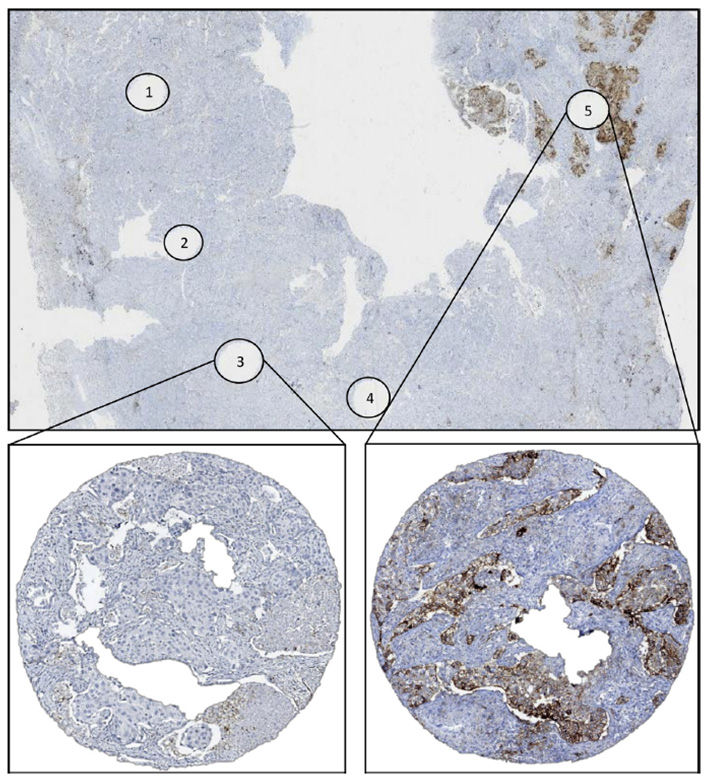
Chart Description: Heterogeneity of IHC tissue stains for protein.
EARLY-STAGE MATTERS
With the rise of neoadjuvant targeted and immunotherapy options, failing to assess PD-L1 and ctDNA status in early-stage patients is a missed opportunity for better outcomes. The traditional approach to molecular testing has primarily targeted advanced disease, but this perspective is now outdated. [6]

Chart Description: Kaplan-Meier curves for (A) PFS and (B) OS by clinical response assessed on CT scans (landmark approach), according to (C) PFS and (D) OS ctDNA detection after neoadjuvant treatment and Kaplan-Meier curves.
UNNECESSARY DELAYS ARE MISSED OPPORTUNITIES FOR BETTER CARE
Standard tissue genotyping can take up to 5 weeks, and waiting for an oncology appointment to draw the liquid biopsy wastes weeks of valuable time, causing a delay treatment decisions as they await critical molecular data.

Chart Description: (B) Comparison of NGS results available at the first oncology visit between cohorts. Tissue results available depicted in gray and plasma NGS results depicted in blue. (C) Percentage of patients receiving a specific treatment recommendation at the first oncology visit.
LIMITED TUMOR ACCESS IS A PROBLEM
Limited or heterogeneous tissue samples can lead to missed mutations and suboptimal therapy choices. [8]
The Cost of
Delayed & Incomplete Testing
Every Missed Mutation =
A Potential Lost Opportunity for Survival
Circulogene OncoGenLDx:
A Better Path Forward
Eliminate the Bottlenecks.
Deliver the Right Therapy from Day One.
LOWER SURVIVAL RATES
Missing EGFR, ALK, PD-L1, and ROS1 keeps patients from receiving therapies that could extend their lives. [9]

Chart Description: Unadjusted survival curves for the available testing group (with or without complete testing) versus the unavailable + comprehensive testing versus the unavailable + incomplete testing groups.
INCREASED HEALTHCARE COSTS
Incomplete profiling leads to repeat biopsies, ineffective treatments, and preventable toxicity, inflating costs for providers and patients alike. [10]
COMPROMISED QUALITY OF LIFE
Treatment delays force patients to endure potential disease progression, worsening symptoms, and lost time with their families.
GUIDELINE-COMPLETE FOR ALL STAGES OF NSCLC
Full 486 gene molecular profiling at diagnosis, including PD-L1 cfRNA analysis, DNA, RNA, MSI, TMB, and PD-L1 in approximately 10 days, providing a clearer picture than tissue biopsies alone. [11]

FASTER TURNAROUND = MORE LIVES SAVED
Results in approximately 10 days, cutting molecular testing turnaround by up to 5 weeks compared to standard tissue genotyping. [7]
COMPLEMENTARY TO TISSUE
Detects low-frequency mutations and immune activity with high sensitivity, eliminating false negatives and missed targets common with tissue testing alone. [11]
FEWER DELAYS, FEWER COSTS, BETTER OUTCOMES
Avoid repeat biopsies, reduce toxicity risks, and get the right treatment started—sooner. [10]

Transforming Care Pathways
Because it Matters
INCREASE SURVIVAL
Fast, comprehensive genomic profiling ensures patients receive personalized life-saving therapies.
Eliminate UNNECESSARY COSTS
Avoid unnecessary and repeat biopsies and ineffective treatments.
STREAMLINE PATIENT CARE
Get answers sooner. Start treatment sooner.
ENHANCE QUALITY OF LIFE
Provide patients with an accelerated time to treatment.
Citations
-
Impact of targeted therapy on the survival of patients with advanced-stage non–small cell lung cancer in Oncosalud-AUNA. J Oncol Pract. 2022;18(2)–e131. doi:10.1200/JOP.21.00567
-
Tsai YH, Kung PT, Wang YH, et al. Effect of time interval from diagnosis to treatment for non–small cell lung cancer on survival: a national cohort study in Taiwan. BMJ Open. 2020;10(4). doi:10.1136/bmjopen-2019-034351
-
Cushman TR, Jones B, Akhavan D, et al. The effects of time to treatment initiation for patients with non–small-cell lung cancer in the United States. Clin Lung Cancer. 2021;22(1)–e97. doi:10.1016/j.cllc.2020.09.004
-
Ilie M, Hofman V, Dietel M, Soria JC, Hofman P. Heterogeneity of PD-L1 expression in non–small cell lung cancer: implications for specimen sampling in predicting treatment response. Ann Oncol. 2019;30(3):357–365. doi:10.1093/annonc/mdy493
-
Sauter JL, Butnor KJ, Borczuk AC, et al. A retrospective evaluation of PD-L1 expression and heterogeneity in early-stage non–small cell lung cancer (REPLICA). Clin Lung Cancer. 2025;26(1)–e9. doi:10.1016/j.cllc.2024.10.005
-
Provencio M, Serna-Blasco R, Nadal E, et al. Overall survival and biomarker analysis of neoadjuvant nivolumab plus chemotherapy in operable stage IIIA non–small-cell lung cancer (NADIM phase II trial). J Clin Oncol. 2022;40(25):2924–2933. doi:10.1200/JCO.21.02660
-
Aggarwal C, Thompson JC, Black TA, et al. Plasma genotyping at the time of diagnostic tissue biopsy decreases time-to-treatment in patients with advanced NSCLC—results from a prospective pilot study. J Thorac Oncol. 2022;17(5):681–689. doi:10.1016/j.jtho.2021.12.005
-
Liam CK, Mallawathantri S, Fong KM. Is tissue still the issue in detecting molecular alterations in lung cancer? Respirology. 2020;25(9):933–943. doi:10.1111/resp.13823
-
Aggarwal C, Marmarelis M, Hwang WT, et al. Association between availability of molecular genotyping results and overall survival in patients with advanced nonsquamous non–small-cell lung cancer. JCO Precis Oncol. 2023;7. doi:10.1200/PO.23.00191
-
Merino MJ, Parikh AR, Li X, et al. The economic value of liquid biopsy for genomic profiling in advanced non–small cell lung cancer. Ther Adv Med Oncol. 2022;14:17588359221112696. doi:10.1177/17588359221112696
-
Leighl NB, Page RD, Raymond VM, et al. Clinical utility of comprehensive cell-free DNA analysis to identify genomic biomarkers in patients with newly diagnosed metastatic non–small cell lung cancer. Clin Cancer Res. 2019;25(15):4691–4700. doi:10.1158/1078-0432.CCR-19-0624
-
Kleinovink JW, Marijt KA, Schoonderwoerd MJA, et al. PD-L1 expression on malignant cells is no prerequisite for checkpoint therapy. Oncoimmunology. 2017;6(1). doi:10.1080/2162402X.2017.1294299
-
Gao Y, Yang J, Cai Y, et al. Role of the tumor microenvironment in PD-L1/PD-1-mediated tumor immune escape. Mol Cancer. 2018;17(1):45. doi:10.1186/s12943-018-0928-4
Performance Characteristics
Test | Panels | Source | Collection | Analytical Sensitivity (LOD95) | Specificity |
|---|---|---|---|---|---|
OncoGenLDx - DNA | SNVs, Indels, CNV, MSI, TMB (486 genes) | Plasma | Streck | > 98% at 2% VAF | > 99.8% |
OncoGenLDx - RNA | RNA Fusion events (72 genes) | Plasma | Streck | >95% | > 99.9% |
OncoGenLDx - PD-L1 | qPCR for RNA (PD-L1) | Plasma | Streck | > 99% | > 94% |